Work Sharp Precision Adjust vs. Ken Onion Elite
By Sora Tanaka • 15th Feb
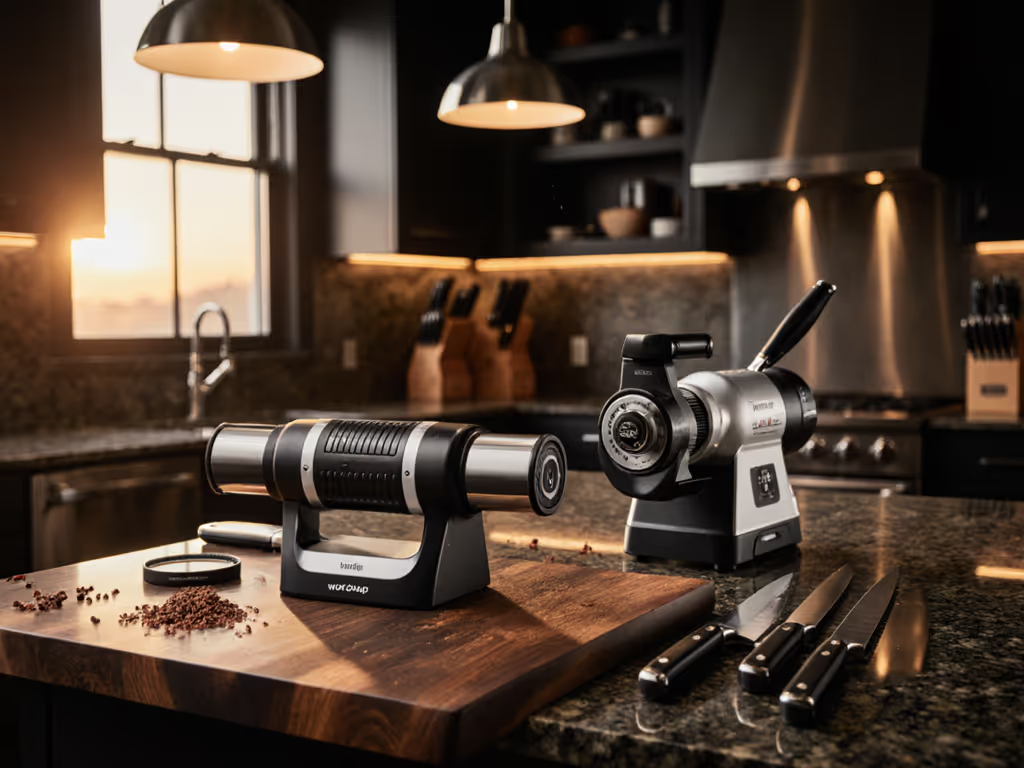
Work Sharp Precision Adjust Elite and Work Sharp Ken Onion Elite represent two fundamentally different philosophies of modern knife sharpening. The former emphasizes controlled, repeatable precision through manual guided progression, while the latter prioritizes motorized speed and edge profile flexibility. Understanding which aligns with your sharpening method, steel types, and skill trajectory is essential before committing to either system.
This guide addresses the most pressing questions that separate casual users from those serious about edge geometry and consistent performance.
What Is the Core Difference in Sharpening Methodology?
The two systems operate on entirely different mechanical principles.
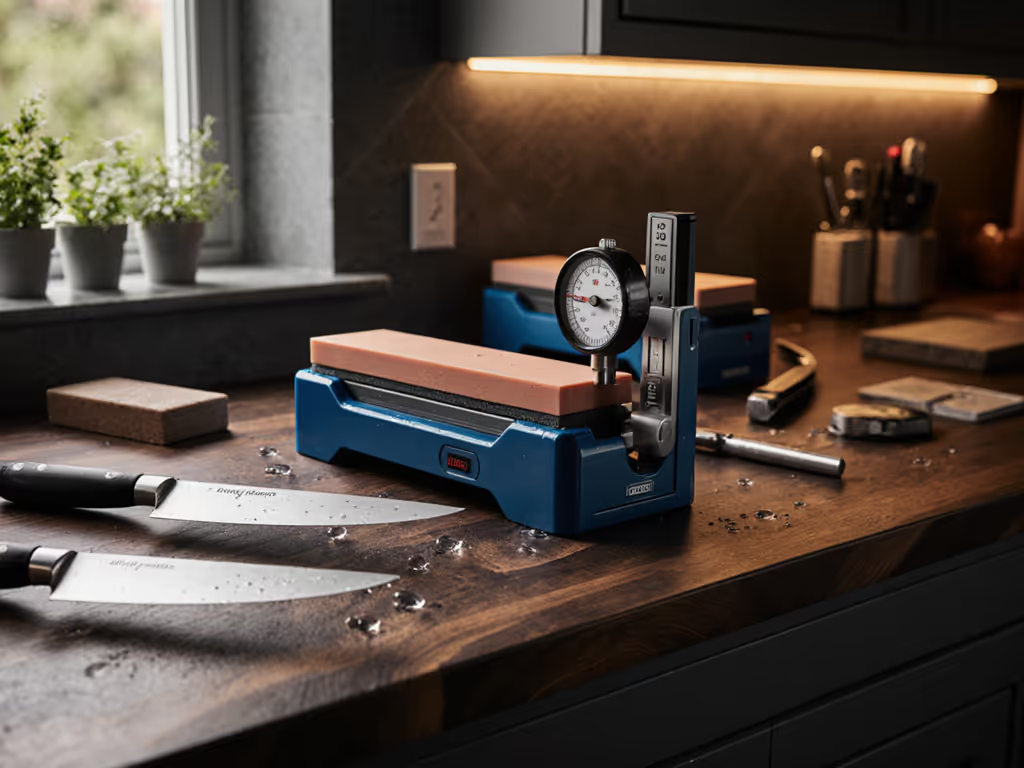
The Precision Adjust Elite uses flat diamond plates, a ceramic hone, resin-bonded diamond stones, and a leather strop (all arranged in a fixed, guided progression). Your knife remains secured in an adjustable clamp while you move it manually through each abrasive stage. For a deep dive into setup and workflow, see our Work Sharp Precision Adjust review. This is a pull-through model: angle is locked in, and repeatability is the system's primary strength.
The Ken Onion Elite, by contrast, employs flexible belt technology with a motorized platform. The belt conforms to your blade's contour, and you can use either the guided Sharpening Cassette or the freehand Blade Grinding Attachment. The motor drives the abrasive surface at adjustable speeds (7 settings on the Mk. 2), giving you active control over how aggressively you attack the edge. For model-specific details, see our Work Sharp Ken Onion Edition review.
Control the angle, control the outcome - steel tells the truth.
When I first began learning edge geometry, my mentor insisted on one principle: feedback is the teacher; the stone is honest. That same ethos applies here. The Precision Adjust locks feedback into its geometry; the Ken Onion demands you interpret the feedback in real time.
Which System Is Faster at Sharpening?
The answer is unambiguous: the Ken Onion Elite.
In direct testing on a Work Sharp Bugout, the Ken Onion Elite completed the job 3-4 times faster than the Precision Adjust Elite. This reflects the inherent advantage of motorized belt speed: you are not manually pushing your blade through multiple stations (the belt is already moving at 40+ surface feet per minute, depending on speed setting).
If speed is your primary metric (perhaps you sharpen many knives or have limited time), the Ken Onion's motorized advantage is decisive. However, faster does not automatically mean better in terms of the checkpoint-driven steps that lead to lasting sharpness.
What About Edge Sharpness - Which Produces a Keener Apex?
According to BESS Tester results (a calibrated device that measures edge acuity in grams of force required to cut a specific medium), the Precision Adjust Elite delivered a sharper initial edge.
Precision Adjust averaged 154 on the BESS scale, scoring well below the 200-point threshold for razor sharp. The Ken Onion averaged 295, still very sharp but measurably duller. To the naked eye, the Precision Adjust produced an almost mirror finish with minimal scratching, while the Ken Onion's finish contained visible sharpening scratches.
This difference stems from flat-ground geometry versus the slight convex profile created by belt sharpening. A flat grind can achieve a more acute apex (that fine point you seek for precise slicing), but that geometry comes with a trade-off.
Which Maintains Edge Better Over Time?
Here, the Ken Onion Elite holds the advantage.
After cutting tests (simulating real use), the Precision Adjust's edge dulled more rapidly, requiring 175 additional grams of force to achieve the same cutting result. The Ken Onion required only 144 additional grams (a meaningful difference if you are slicing through hundreds of tomatoes or processing game).
The reason: the convex edge generated by belt sharpening retains more material at the cutting point. That rounded geometry sacrifices micro-sharpness but gains durability and edge strength under lateral stress. Over a six-month period of regular use, this durability margin compounds.
This reflects a deeper principle: consistency over speed. A slightly less acute edge that holds its geometry through 500 cuts is more valuable than a razor-sharp apex that dulls after 200.
Which Is Better for Beginners?
The Precision Adjust Elite is the clear winner for newcomers.
Reasons:
- Angle control is entirely automated: The clamp and guide system remove guesswork. You cannot accidentally shallower your angle mid-stroke.
- Progression is pre-determined: Move from coarse to fine; the sequence is locked in. No decisions about grit order or dwell time.
- Lower skill floor: You can produce a genuinely sharp, mirror-polished edge on your first attempt. The system handles the geometry; you provide gentle pressure.
- Consistent results immediately: Beginners often struggle with angle consistency on freehand or semi-guided systems. The Precision Adjust eliminates this feedback loop entirely.
The Ken Onion, while powerful, requires understanding belt speed selection, angle control during the stroke, and when to lighten the finishing passes. These are learnable, but they demand deliberate practice with clear feedback loops (not ideal when you are still building confidence).
What About Edge Finish Quality (Polish vs. Utility)?
If your priority is a visually polished, reflective edge, the Precision Adjust Elite wins decisively. Its diamond and leather progression leaves the blade almost mirror-bright, with minimal visible scratching.
The Ken Onion produces a functional but less refined finish (visible striations from the belt remain), though they do not meaningfully impact cutting performance. This is the trade-off for speed and convex geometry.
For professional kitchen work or formal plating, finish matters aesthetically. For backcountry, EDC, or production prep work, finish is cosmetic (the convex utility edge is preferable).
How Do They Handle Different Steel Types?
Both systems feature diamond and ceramic abrasives, making them suitable for modern super steels (S35VN, M390, etc.) that resist traditional whetstones.
The Precision Adjust offers resin-bonded diamond plates, which load slightly less than mono-crystal diamond and may feel more forgiving on high-hardness stainless. The Ken Onion's flexible belt conforms to blade contours, making it better suited for recurves, cleavers, and irregularly shaped edges.
For a chef's knife or standard EDC blade in conventional stainless or carbon steel, both are equivalent. For specialty shapes or hard exotics, the Ken Onion's flexibility gives it an edge.
What Are the Angle Ranges?
Both systems offer 10° to 35° adjustability. For practical angle picks by knife type, read our 15° vs 20° angle guide.
This range covers almost every practical use case: 10-15° for Japanese razors and sushi knives, 15-20° for kitchen cutlery and EDC folders, 25-35° for chopping blades and outdoor tools. The Precision Adjust features a digital angle indicator for precision confirmation; the Ken Onion uses leather-lined angle guides that lock in mechanically.
What About Maintenance and Long-Term Costs?
The Precision Adjust Elite requires periodic lapping of its diamond and ceramic plates to maintain flatness (especially after heavy use on hard steels). This is a manageable but ongoing cost.
The Ken Onion Elite uses replaceable belts. Abrasive belts wear over time and must be swapped out (typically after 50-100 sharpenings, depending on steel hardness and stroke pressure). Belt replacement is straightforward but a recurring expense.
Neither system is maintenance-free. Plan for periodic investment, and factor belt replacement (Ken Onion) or lapping service (Precision Adjust) into your long-term budget. See the 5-year knife sharpening cost breakdown before you commit.
Which Is Better for Small Spaces or Noise-Sensitive Environments?
The Precision Adjust Elite is silent and compact. It requires only hand pressure and produces no motor noise or vibration (ideal for apartments, late-night use, or shared kitchens).
The Ken Onion Elite is motorized and generates belt noise (not deafening, but audible). The 7-speed motor can be lowered for quieter operation, but it will never match the silence of manual guided sharpening.
If your environment is space- or noise-constrained, the Precision Adjust is the pragmatic choice. For compact setups, check our small-kitchen sharpener picks.
Which System Offers More Versatility?
The Ken Onion Elite wins on versatility.
Its Blade Grinding Attachment enables freehand work on specialty edges (serrations, recurves, axes, cleavers). The Sharpening Cassette provides guided sharpening for standard blades. A single system handles kitchen knives, pocket knives, outdoor tools, and custom blade shapes.
The Precision Adjust is optimized for standard knives up to 1/4 inch thick and 18 inches long. Specialty shapes and freehand work fall outside its design envelope.
For a collector or someone who sharpens diverse blade types, the Ken Onion's flexibility is valuable.
How Do the Two Compare in a Side-by-Side Test?
Multiple direct comparisons confirm a consistent pattern:
| Metric | Precision Adjust Elite | Ken Onion Elite |
|---|---|---|
| Speed | Slow (manual process) | 3-4x faster (motorized) |
| Initial sharpness (BESS) | ~154 (razor sharp) | ~295 (very sharp) |
| Edge retention after use | Weaker (~175g force increase) | Stronger (~144g force increase) |
| Visual finish | Mirror polish with minimal scratches | Functional with visible striations |
| Angle consistency | Locked (digital indicator) | User-controlled (requires skill) |
| Ease for beginners | Excellent (guided) | Moderate (requires technique) |
| Versatility | Standard blades only | Specialty shapes, freehand capability |
So Which Should You Choose?
Choose the Precision Adjust Elite if:
- You prioritize consistency and repeatability over speed.
- You are sharpening primarily standard kitchen or folding knives.
- You value a polished, mirror-finish edge.
- You want a quiet, compact system for space-limited environments.
- You are a beginner and want to remove guesswork entirely.
- You sharpen infrequently and want foolproof results.
Choose the Ken Onion Elite if:
- You sharpen frequently and value speed (3-4x advantage).
- You work with diverse blade types (kitchen, EDC, outdoor, specialty shapes).
- You are willing to invest in learning motorized control and freehand technique.
- You prioritize edge retention and durability over initial micro-sharpness.
- You need the Blade Grinding Attachment for recurves, serrations, or custom profiles.
- Your space accommodates a motorized system and minor motor noise.
- You appreciate flexibility in angle and edge geometry (convex, flat, or hybrid).
What's the Path Forward?
Your decision hinges on three checkpoints:
- Skill level and patience: Beginners and time-pressed users lean Precision Adjust. Those building deliberate technique lean Ken Onion.
- Blade diversity: One specialized knife? Precision Adjust. Multiple blade types and shapes? Ken Onion.
- Space and noise constraints: Silent and compact? Precision Adjust. Motorized power acceptable? Ken Onion.
Both systems deliver genuinely sharp edges (far sharper than factory defaults). Neither is wrong. The choice is about alignment with your workflow, steel types, and the feedback loops that matter to you.
If you are considering a Work Sharp system for the first time, spend time reading reviews and watching side-by-side test footage from experienced users. Listen closely to descriptions of the edge quality they value, not just the speed or flash. That alignment of priorities with your own will tell you which path serves your edges (and your mastery) best.
The steel is honest. The system you choose should be, too.
Related Articles