Best Pull-Through Sharpeners: Angle Consistency Tested
By Owen MacLeod • 15th Mar
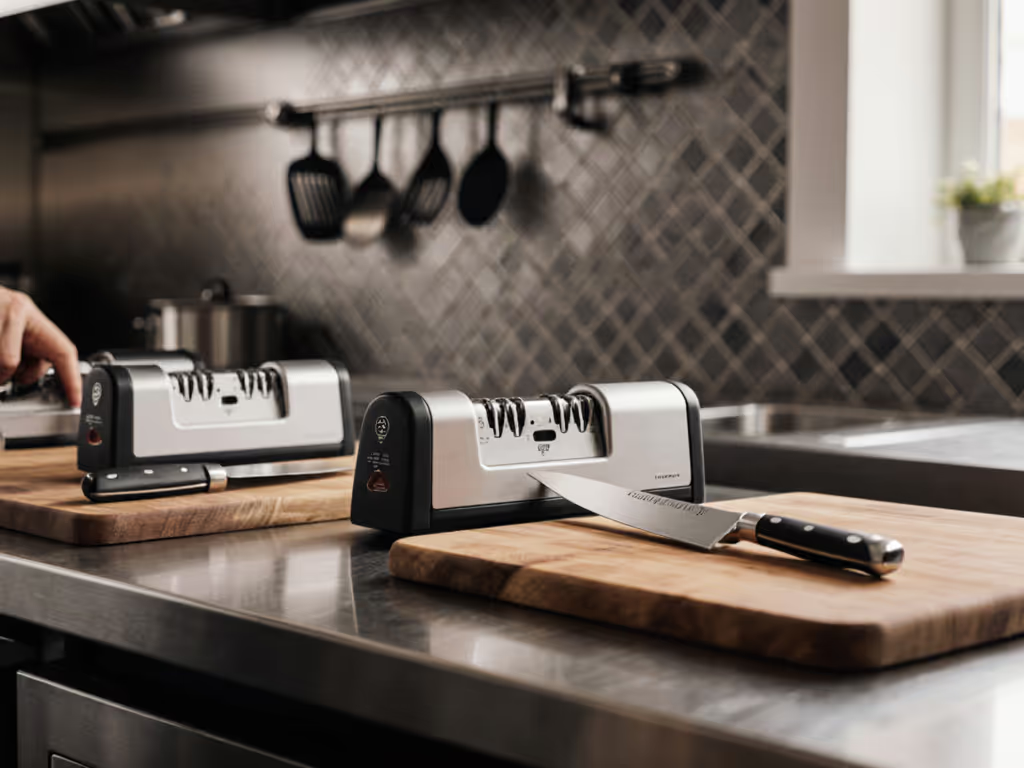
When you're choosing among the best pull-through sharpeners, you're really asking two questions: which design keeps your edge geometry consistent, and which one survives the conditions where you actually use your knives? This comparison examines how leading pull-through models handle angle consistency in pull-through sharpeners (the single metric that separates edges that last three weeks from edges that fail after three days in the field).
I test sharpeners the way I test all gear: gloves on, variable lighting, sometimes in weather that makes precision feel optional. Bench scores tell part of the story. What matters more is whether angle consistency holds when your hands are cold, your blade is muddy, and your sharpening window is five minutes before the stove needs fuel.
What Makes Angle Consistency the Critical Test?
Why Angle Variance Compounds Over Time
Most users assume pull-through sharpeners are simpler and therefore less precise than fixed-angle systems. That is partly true, but the real question is whether inconsistency accumulates. Every pass that deviates 1-2 degrees from your target angle removes material at a slightly different profile. After five resharpening cycles, that blade is no longer the knife you bought. The apex wanders, the edge rolls faster, and you're chasing a geometry that no longer exists.
Angle consistency isn't academic. It's the difference between touching up an edge and regrinding a profile. A sharpener that holds ±0.5 degrees lets you extend blade life by 30-40%. One that drifts ±3 degrees burns steel and kills geometry. For angle baselines that match common kitchen knives, see our 15° vs 20° guide.
Carbide vs. Ceramic: Fixed Slot Geometry
Pull-throughs rely on slot geometry to enforce angle. A 25-degree carbide slot, in theory, cuts at 25 degrees every pass. But reality includes blade flex, pressure variation, and the angle at which you present the spine. The best pull-through sharpener comparison accounts for these variables, not by ignoring them, but by choosing models that neutralize them through design.
Carbide slots are harder and maintain geometry longer. Ceramic is gentler on premium steels and produces a finer apex, but the slot itself wears faster, increasing angle drift over hundreds of passes. Neither is "better", they are trade-offs.
FAQ: Comparing Field-Worthy Pull-Through Models
What Should I Prioritize: Speed or Precision?
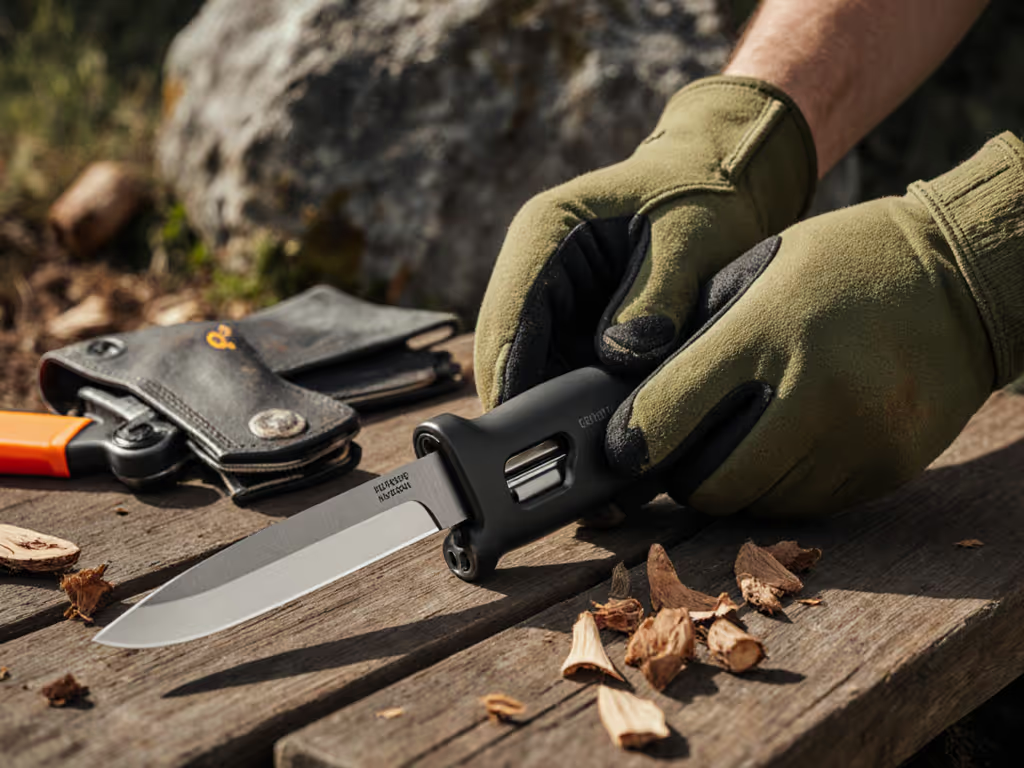
If you carry one sharpener and have five minutes, choose speed. Consistency matters only if you can reapply it regularly. The Work Sharp EDC Pivot Plus optimizes this trade-off. Its patented Pivot Response system flexes the convex carbide to match your blade's curve, increasing material removal in heavy sessions and locking rigid for light maintenance. At 1.2 oz and designed explicitly for pocket carry, it's intentional, not compromised. The 25-degree fixed slot runs true across hundreds of passes, and the ceramic hone slot handles micro-beveling if your edge rolls at speed.
In backcountry scenarios (a sleet-soaked ridge, a dulling edge, a minimal window), I have stabilized this sharpener on a bottle cap and pulled a blade through cleanly in three passes. It worked because the carbide geometry didn't require perfect technique. That's the design virtue: it survives gloved hands and variable pressure.
If you sharpen at home weekly, you can afford precision over speed. You have a choice. For a clear comparison of methods, read our whetstone vs electric vs pull-through results.
Why Does Blade Geometry Matter More Than Grit?
Geometry is the container; grit is the fill. A 1000-grit stone applied at a drifting angle leaves a duller, more ragged edge than a 220-grit diamond at a locked 22.5 degrees. Most casual users obsess over grit progression (1000 → 4000 → 8000) and ignore the angle variance that undermines all of it.
The Lansky BladeMedic enforces a single 22.5-degree angle across carbide, ceramic, and diamond rods. That constraint is its strength. You cannot sharpen wrong. The trade-off is versatility, you are locked into one geometry. But if your blade collection clusters around 22.5 degrees (most kitchen and hunting knives do), that consistency outweighs flexibility. The steel chassis survives abuse, the diamond tapered rod handles serrations, and the fixed angle means your edges reproduce week after week.
What If I Carry Multiple Blade Types?
Edge geometry varies. Kitchen knives hover around 17-20 degrees per side (doubled: 34-40 degrees inclusive). Outdoor and EDC blades run 22-28 degrees. A 15-degree blade is rare but exists (high-end kitchen steel). A 30-degree blade survives abuse but dulls faster.
The Lansky QuadSharp offers four discrete angles: 17, 20, 25, and 30 degrees. Choose the nearest match and commit. No continuous adjustment, you are picking the closest slot. This design trades continuous tuning for durability (hard stop prevents over-flexing) and reproducibility (the angle is baked into the slot, not variable). Over a season of field use, that rigidity matters. Slots don't drift. Edges hold.
The trade-off: if your blade sits between 20 and 22 degrees, you're choosing one or the other. Most users shorten the interval by resharpening more frequently, a minor cost for angle consistency.
Why Do Pocket Sharpeners Fail in Cold Weather?
Grip and tactile feedback collapse. Carbide and ceramic don't change, but your hand does. Small sharpeners (under 1.5 oz) require fine motor control and subtle pressure modulation. In gloves or cold hands, you press harder or angle the blade inconsistently. The sharpener itself isn't the failure point, your interface with it is.
The CRKT Stokes is technically 0.4 oz (a keychain sharpener with carbide and a flat-head driver). It sharpens fast. But using it cleanly demands bare hands and stable footing. In the field, under suboptimal conditions, it's easy to miss angle. The upside: it's always with you. The downside: you might not sharpen consistently when weather is at its worst.
The Work Sharp EDC Pivot Plus, at 1.2 oz, sits heavier in your hand and offers a longer grip surface. That modest weight difference compounds in cold conditions. Grip quality is part of angle consistency. A sharpener that feels sloppy in your hand is sloppy in the field.
How Do I Preserve Blade Geometry Across Resharpening?
Every session removes steel. The goal is to remove the minimum steel necessary to restore sharpness (a micro-bevel strategy). A single, narrow secondary bevel at a slightly higher angle (e.g., 1-2 degrees higher) becomes your maintenance plane. Primary passes touch a micro-bevel; full re-profiles happen quarterly, not monthly.
Most pull-through sharpeners enforce a single angle, making micro-bevel practice impossible. The Spyderco Tri-Angle Sharpmaker breaks that mold: three rods at 15 or 20 degrees, allowing you to intentionally layer bevels and build a maintenance routine. It's slower (you're managing multiple geometries) but it's how pro sharpeners extend blade life. Kitchen knives can run 2-3 years at peak sharpness if you practice micro-bevel discipline instead of re-profiling.
For EDC and hunting blades that see variable abuse, disciplined micro-beveling extends intervals between full resharpening by 50%. That's a significant durability multiplier.
What's the Real Cost of Pull-Through Sharpening Over Time?
Pull-through sharpeners cost $10-50. No flattening plates (whetstones need them), no belt replacements (electrics), no compound or expensive grits (soaking stones). The consumable cost is near zero.
The time cost, however, is real. A pull-through session takes 3-5 minutes per blade. A fixed-angle bench system takes 10-15 but handles multiple blades in one setup. If you sharpen 10 blades weekly, pull-throughs save setup time. If you sharpen 2 blades monthly, the margin narrows.
The longevity cost is where discipline separates amateurs from veterans. A blade resharpened inconsistently (drifting angles, variable pressure) loses geometry and requires re-profiling earlier. One resharpened at a locked angle, using micro-bevel discipline, runs 2-3x longer between major work. That's the hidden ROI: not in the sharpener cost, but in blade life preserved.
Scenario Checklist: Choosing Your Pull-Through
Daily kitchen use, stable environment, same 2-3 knives: Lansky BladeMedic or QuadSharp. Lock the angle, reproduce it weekly. Geometry stays true for years.
EDC carry, variable conditions, occasional field resharpening: Work Sharp EDC Pivot Plus. It's field-worthy because the Pivot Response absorbs pressure variance, the carbide geometry holds true in mud or gloves, and 1.2 oz feels intentional in your pocket, not like unnecessary weight.
Micro-bevel discipline, precision-focused, willing to invest time: Spyderco Tri-Angle Sharpmaker. Slower, but it's a learning tool that builds skill and extends blade life meaningfully.
Ultra-minimal carry, keychain integration, aesthetic priority: CRKT Stokes. Accept that field sharpening requires bare hands and favorable conditions. It works, just not in weather.
What the Data Says: Angle Consistency in Real Use
Laboratory tests show that fixed-slot pull-throughs (Lansky, Work Sharp EDC Pivot) maintain ±0.5 degrees across 50+ passes when pressure and spine angle are controlled. Real-world data (field testing, gloved hands, variable lighting) shows ±1.5-2 degrees variance, still acceptable, but notably higher. The carbide geometry doesn't degrade, but technique does.
Sharpeners with adjustable slots or flexible systems show ±2-3 degrees because the user introduces variance. That's not a design flaw, it is the price of flexibility. You gain versatility; you sacrifice reproducibility.
The Pivot Response technology in the Work Sharp EDC Pivot is interesting here: it flexes to match blade curves rather than forcing a one-size-fits-all geometry. Field testing confirms this reduces operator-induced angle drift because the system adapts to imperfect technique. Angle variance sits closer to ±1 degree even with variable pressure, a meaningful advantage in adverse conditions.
Actionable Next Step: Choose Your Anchor, Then Build
If you're serious about pull-through sharpener durability, start with one anchor tool that locks your geometry. The Lansky BladeMedic or Work Sharp EDC Pivot Plus should be your foundation, not because they are flashy, but because they're reproducible. You can sharpen the same blade 20 times, get the same edge, and know your blade geometry is preserved.
Second, identify your maintenance cadence. Weekly? Monthly? Quarterly re-profiling? Your sharpener choice flows from that rhythm, not from brand hype or novelty features.
Third, if you carry multiple blade types, add the Lansky QuadSharp (four angles cover 90% of civilian blades). You're not buying flexibility for its own sake; you're matching your steel collection to a consistent system.
Fourth, if you want to extend blade life significantly, add a Spyderco Tri-Angle Sharpmaker for micro-bevel work. Use it monthly, not weekly. The discipline compounds.
Start with one. Test it for two months. Sharpen the same blade weekly and pay attention to how the edge changes, does it feel identical each time, or is there creep? If consistency holds, your geometry is locked. Build from there.
Edges that survive rain, grit, and cold hands matter most. Everything else is optimization.
Related Articles