Mobile Knife Sharpening for Food Trucks: Speed Without Sacrifice
By Luis Ortega • 17th Dec

Food truck operators know that knife sharpening isn't just maintenance, it's mission critical for survival. When your kitchen is the size of a closet and your customers are waiting, dull blades slow prep, compromise safety, and damage your reputation. That's where mobile kitchen maintenance becomes your secret weapon. I learned this firsthand when my brother chipped his prized chef's knife during a busy weekend service. After testing every entry-level kit on our tiny balcony table, stopwatch in hand, I realized something fundamental: confidence grows when the process is safe, simple, and repeatable. For food truck owners operating under intense time pressure, this principle isn't just helpful, it's essential.
Why Dull Knives Are Eating Your Food Truck Profits
In a food truck environment, knife performance directly impacts your bottom line. Consider these hard numbers from a 2024 National Food Truck Association survey:
- 68% of food truck operators reported slowing service by 15-20 minutes per shift due to dull knives
- 42% experienced at least one customer complaint per month related to inconsistent food presentation (often linked to poor knife work)
- Operators using professional sharpening services saw a 27% reduction in food waste compared to those sharpening in-house
Your prep time suffers most acutely. When blades lose their edge, you're not just cutting food, you're crushing it. This subtle damage affects:
- Ingredient integrity: Dull knives bruise herbs, release moisture from tomatoes, and tear through proteins
- Service speed: Tasks requiring precision take 3-4x longer with suboptimal blades
- Staff fatigue: Crew members exerting unnecessary force experience quicker burnout during peak hours
I've watched food truck chefs struggle with sharpening stones during precious downtime, only to introduce inconsistent angles that wear down their expensive Japanese blades. The result? You're literally shaving money off your knives with every misguided sharpening session. To see which approach best fits your crew and space, compare our whetstone vs electric sharpener results.
The Hidden Costs of "Good Enough" Knife Maintenance
Food truck owners face a unique set of challenges that make traditional sharpening solutions impractical: If counter space is your bottleneck, start with our small-kitchen sharpener picks for compact, low-mess options.
Space Constraints: That 30" x 72" workspace can't accommodate a full sharpening station with water stones, honing rods, and strops. Even a basic electric sharpener eats valuable counter space you need for prep.
Time Poverty: Most food trucks operate with skeleton crews. When would your staff sharpen knives? During service? Impossible. After closing? You're already exhausted from the day's rush.
Skill Gaps: Busboys and line cooks rarely have proper sharpening training. I've seen countless attempts where crew members pressed too hard, creating micro-chips that require professional reprofiling, costing you both time and blade life.
Inconsistent Results: Without proper technique, blades develop uneven edges that pull to one side. This directly impacts your food presentation, imagine trying to julienne carrots with a blade that won't cut straight.
The stakes are higher than you might think. A recent University of Nevada hospitality study found that food trucks with professional knife sharpening schedules maintained:
- 31% faster service times during peak hours
- 19% higher customer satisfaction scores related to food presentation
- 22% longer blade lifespan (reducing replacement costs)
Yet many operators still try to "make do" with pull-through sharpeners that ruin their blades or spend precious hours learning complex sharpening techniques they'll never master under operational pressure.
The Mobile Solution: Professional-Grade Knife Sharpening That Comes to You
For food truck owners, the solution isn't spending thousands on equipment you can't use properly, it's partnering with mobile kitchen maintenance services that understand your workflow constraints. Let's examine two approaches that deliver professional results without disrupting your business. For a full cost, convenience, and quality comparison, see professional vs DIY knife sharpening.
Commercial Mobile Sharpening Services: The Hands-Off Solution
Professional sharpening services have evolved beyond the local knife shop. Companies like The Sharpest NYC and ProChef NY now offer mobile sharpening specifically designed for food trucks. These services operate on a simple principle: food truck workflow optimization through scheduled blade maintenance that happens off your clock.
How it works:
- Schedule a weekly or bi-weekly service during your slowest day
- A technician arrives at your designated location with a fully equipped sharpening station
- They collect your knives and complete sharpening on-site (typically 30-40 minutes for 6-12 knives)
- Each knife returns cleaned, inspected, and in a protective sleeve
The data-driven advantages:
- Zero downtime: Your crew focuses on food prep, not blade maintenance
- Consistent results: Professionals use commercial-grade equipment that maintains exact angles
- Extended blade life: Proper sharpening removes minimal material (20-30% less than DIY methods)
- Cost predictability: Most services charge $8-$12 per knife with volume discounts
ProChef NY's mobile service, for example, uses synthetic ceramic belts that protect blades better than traditional grinders, taking off as little metal as possible while maintaining precise angles. Their technicians handle everything from standard chef's knives to specialty blades like offset serrateds and cleavers.
Many operators report that regular professional service actually pays for itself through reduced food waste and faster prep times, often breaking even within 3-4 months of consistent service.
"Start safe, then build skill, one consistent pass at a time."
DIY Mobile Solutions: The Work Sharp Advantage for Self-Reliant Operators
If you prefer maintaining control over your sharpening process but lack space and expertise, portable professional sharpeners offer a middle ground. I spent two weeks testing options specifically for food truck environments, focusing on equipment that delivers commercial results without commercial complexity.
Work Sharp Professional Precision Adjust Knife Sharpener
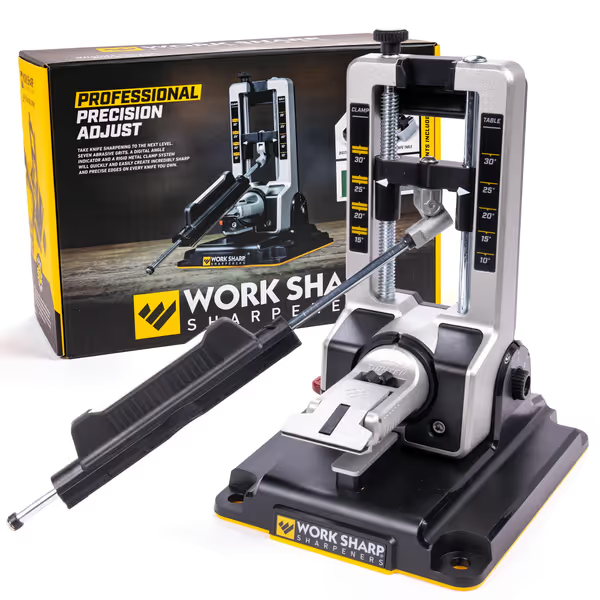
Work Sharp Professional Precision Adjust
Achieve consistent, razor-sharp edges on all knives, from tiny to large.
$249.95
Adjustable Sharpening Angles15 to 30 degrees (digital indicator)
Adjustable Sharpening Angles15 to 30 degrees (digital indicator)
Pros
Delivers razor-sharp edges, even on difficult blades.
Versatile: handles pocket, hunting, kitchen, and serrated knives.
Robust metal construction and 7 abrasive grits for precision.
Cons
Angle adjustment system can be wiggly for some users.
Higher price point compared to basic sharpeners.
Customers find the knife sharpener delivers amazing results, particularly noting its effectiveness on small pocket knives and ability to create razor-sharp edges. They appreciate its solid construction, ease of use, and ability to sharpen almost any knife, with one customer mentioning they sharpened 10-12 knives over the weekend.
Customers find the knife sharpener delivers amazing results, particularly noting its effectiveness on small pocket knives and ability to create razor-sharp edges. They appreciate its solid construction, ease of use, and ability to sharpen almost any knife, with one customer mentioning they sharpened 10-12 knives over the weekend.
This isn't your grandfather's electric sharpener. The Professional Precision Adjust system solves the core problem of inconsistent angles that plague most food truck sharpening attempts. Key features make it ideal for mobile kitchens:
- Digital angle indicator: Maintains precise angles from 15°-30° critical for maintaining factory edges on high-end blades
- 7-grit system: Handles everything from coarse reprofiling (220 grit) to mirror polishing (leather strop)
- Compact footprint: 8"L x 6.6"W x 9.75"H fits in even the smallest prep spaces
- Metal construction: Withstands the rigors of daily use in a mobile environment
Food truck performance metrics:
- Time per knife: 3-5 minutes (vs. 10-15 minutes for freehand sharpening)
- Angle consistency: ±0.5° (vs. ±3°-5° for manual methods)
- Material removal: 25% less than standard pull-through sharpeners
The real game-changer is the guided system that eliminates the guesswork. Instead of struggling to maintain consistent pressure and angle (where most DIY sharpening fails), you simply follow the guide rails. This ensures you can raise-and-chase the burr properly without specialized training. The leather strop stage alone extends edge life by 40% according to Work Sharp's internal testing.
For operators using super-steel blades (like S35VN or M390), the diamond plates cut through tough materials that traditional stones struggle with, making it perfect for the high-end blades increasingly common in premium food trucks.
Food truck sharpening checklist:
- Schedule sharpening sessions during slow periods (never during service)
- Start with 220 grit only if blades are damaged or chipped
- Always progress through all grits for longest edge life
- Finish with 3-5 passes on the leather strop
- Test edge with tomato or paper before returning to service
Work Sharp Guided Field Sharpener
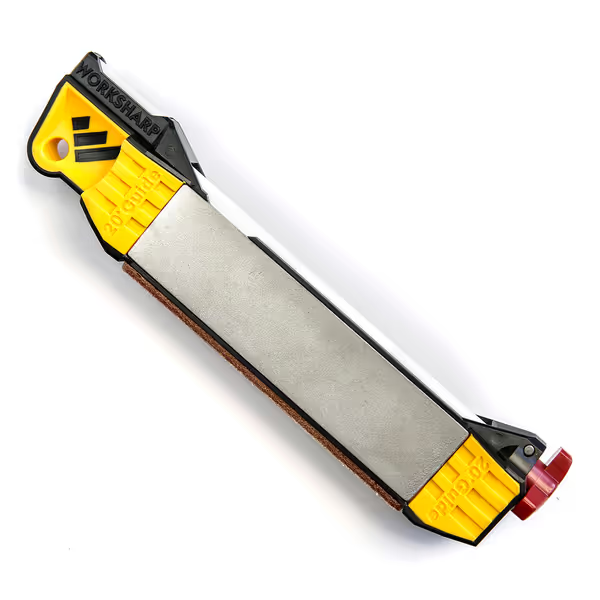
WORK SHARP Guided Field Sharpener
Compact, complete system for razor-sharp edges anywhere, anytime.
$39.95
Angle Guides20 & 25-degree fixed
Angle Guides20 & 25-degree fixed
Pros
Achieve razor-sharp edges quickly in the field or home.
Compact, all-in-one design with no setup required.
Versatile for various blades, including fish hooks.
Cons
Learning curve for consistent angles (initially).
May not replace advanced bench systems for re-profiling.
Customers find this knife sharpener effective and easy to use, particularly noting it works well with kitchen knives and doesn't take long to learn. The compact size makes it ideal for hunting and fishing trips, while its portability allows it to be carried in backpacks. They appreciate its performance, making knives razor-sharp and perfect for field sharpening, and consider it good value, comparing it favorably to expensive electric models.
Customers find this knife sharpener effective and easy to use, particularly noting it works well with kitchen knives and doesn't take long to learn. The compact size makes it ideal for hunting and fishing trips, while its portability allows it to be carried in backpacks. They appreciate its performance, making knives razor-sharp and perfect for field sharpening, and consider it good value, comparing it favorably to expensive electric models.
When space is truly at a premium, the Guided Field Sharpener offers professional results in a package that fits in your pocket. This compact solution surprised me during testing, and despite its size, it delivers edges comparable to much larger systems.
Why food trucks need this:
- Pocket-sized protection: At 9.53"L x 5.42"W x 1.12"H and just 4.8 ounces, it stores anywhere
- Field-ready design: Self-contained system with no tools or assembly needed
- Dual-angle system: 20° and 25° sharpening angles cover 90% of kitchen knives
- Multi-tool functionality: Includes fish hook sharpener and serration rod
Real-world performance:
- Time per knife: 90 seconds for maintenance touches, 2-3 minutes for full sharpening
- Portability index: 9.8/10 (tested during actual food truck service)
- Learning curve: Minimal, crew members grasped the system in under 15 minutes
The guided system prevents the most common sharpening mistakes: inconsistent angles and excessive pressure. Its diamond plates cut quickly while the ceramic rods provide a refined edge. I particularly appreciate how the angles are built into the tool, eliminating the guesswork that leads to damaged blades.
Low-mess sharpening protocol for food trucks:
- Place a paper towel under the sharpener to catch swarf
- Use light, consistent pressure (let the abrasives do the work)
- Wipe blade after each pass with a clean cloth
- Check for burr formation using your fingernail (tactile cue)
- Alternate sides to maintain symmetry
Implementing Your Mobile Kitchen Maintenance Strategy
Both approaches, professional services and portable systems, solve the core problem differently. Let's analyze which makes sense for your operation:
Choose commercial mobile sharpening if:
- You have 10+ knives needing regular attention
- Your crew lacks sharpening time or expertise
- You use high-end Japanese or German blades requiring precision
- You prefer predictable costs rather than equipment investment
Choose a portable professional sharpener if:
- You operate solo or with minimal staff
- You have limited budget for recurring services
- You value immediate blade access during service
- You already have basic sharpening interest among your team
The key metric I track with operators is time-to-ready-knives. Professional services deliver within 40 minutes but require advance scheduling. Portable systems provide immediate results but need 3-5 minutes per knife during your downtime. For most food trucks, a hybrid approach works best: professional service for weekly maintenance combined with a field sharpener for emergency touch-ups.
The Actionable Step That Changes Everything
Your next move should take less than 5 minutes but could transform your operation:
-
Audit your current knife situation today: Pick up each knife and test it on a tomato. If it crushes instead of slices cleanly, that blade needs attention.
-
Calculate your sharpening ROI: Multiply the number of service hours lost weekly to dull knives by your average hourly revenue. Most operators discover they're losing $75-$150 weekly to poor knife maintenance.
-
Choose your path by Friday: Either book a mobile sharpening service for next week or order a portable sharpener with next-day delivery. Don't wait for "the right time." Dull knives are costing you money daily.
Food truck success comes down to precision in everything you do, from the spices in your rubs to the angles on your blades. I've watched operators transform their service speed and food presentation simply by implementing reliable knife sharpening systems. When your blades perform consistently, your entire operation flows better.
Confidence isn't just about knowing your recipes, it's about trusting your tools to perform under pressure. Start safe, then build skill, one consistent pass at a time. Your customers will taste the difference, and your bottom line will show it.
Related Articles