Work Sharp vs HORL: Precision Sharpening Test
By Sora Tanaka • 7th Mar
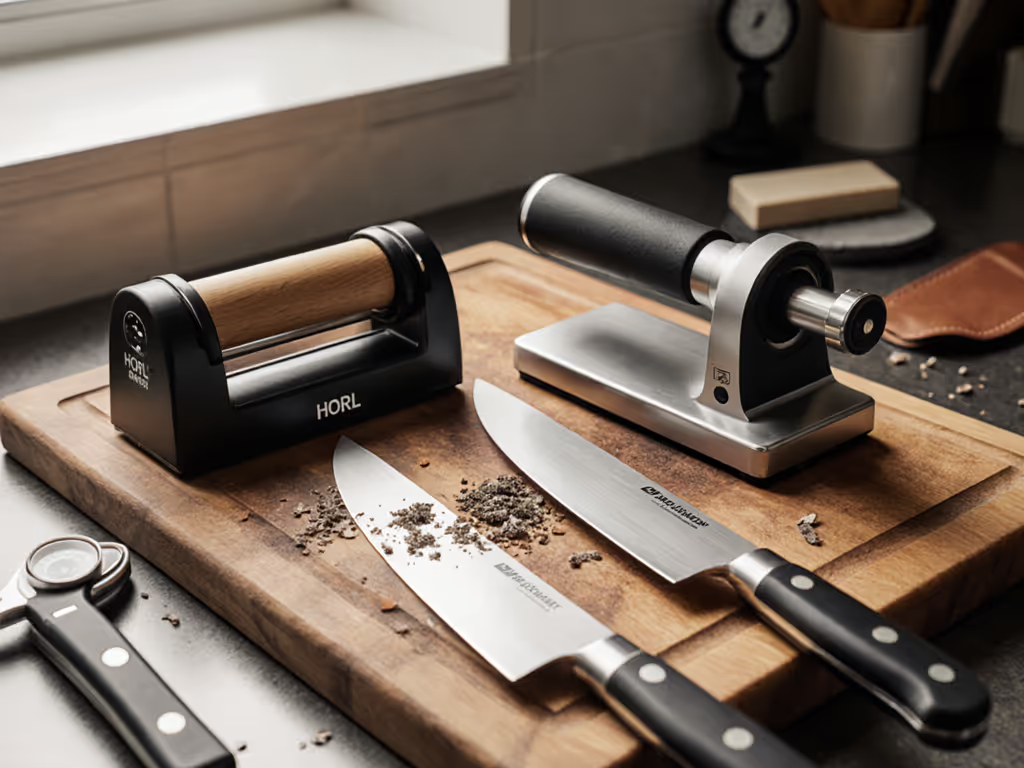
Work Sharp vs HORL systems represent two distinct philosophies for home knife sharpeners: one emphasizes versatility and adjustability, while the other prioritizes consistency and tactile feedback through magnetic-guided rolling mechanics. Both employ fixed-angle approaches to eliminate guesswork, but their execution, and real-world performance, differ in ways that matter most to outcome-driven users seeking repeatable, measurable results.
What Are Magnetic Guide Sharpeners, and Why Do They Matter?
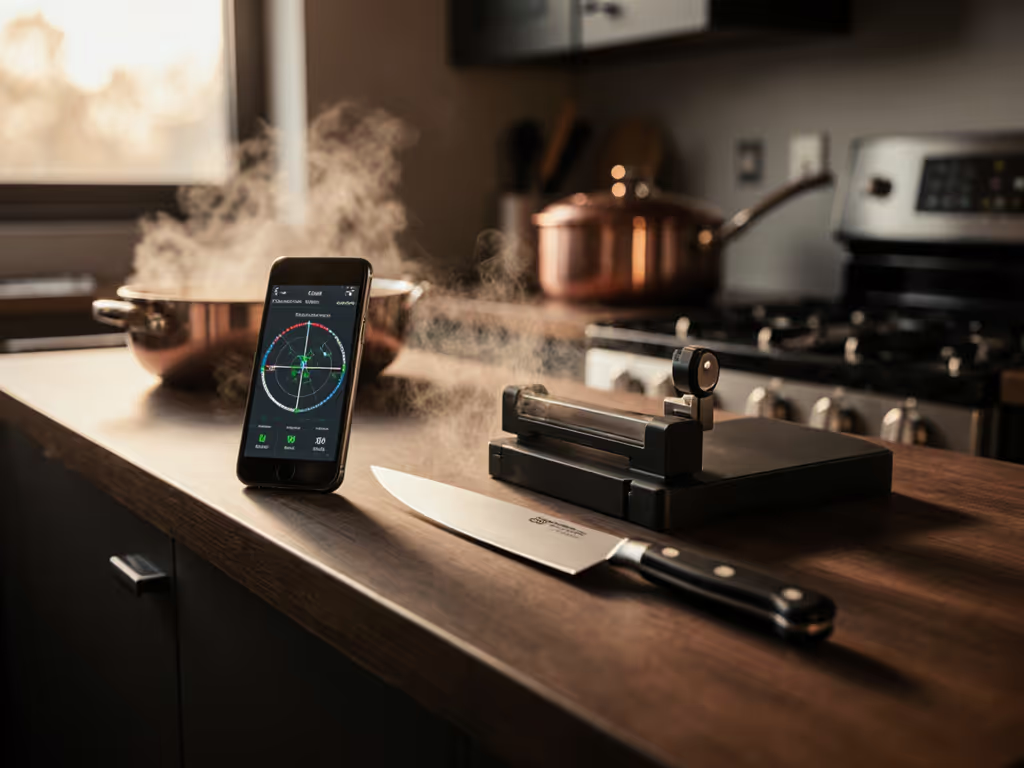
Magnetic guide sharpeners remove the angle-determination problem that plagues stone users. Rather than asking you to hold a 15- or 20-degree bevel steady by hand, these systems lock your knife in place via magnetic contact and guide the abrasive at a fixed angle.[2] If you're unsure which angle suits your knives, see our 15° vs 20° guide. This checkpoint (knowing your angle is controlled) builds confidence and eliminates the most common source of uneven sharpening: human inconsistency.
Years of informal apprenticeship with a retired sharpener reinforced one principle: feedback is the teacher. On a 1,000-grit stone, I spent Saturday mornings chasing the burr (that moment when the abrasive reaches fresh steel and the resistance changes). The stone doesn't lie; your hands do. Magnetic systems collapse that feedback loop into a physical constraint, which works for many, but at a cost we will address.
HORL: The Consistency Play
The HORL 2 and HORL 3 are rolling sharpeners with interchangeable diamond and ceramic discs. The fundamental design pairs a fixed-angle magnetic guide with a spinning disc that you roll across the blade.[2]
Edge Results
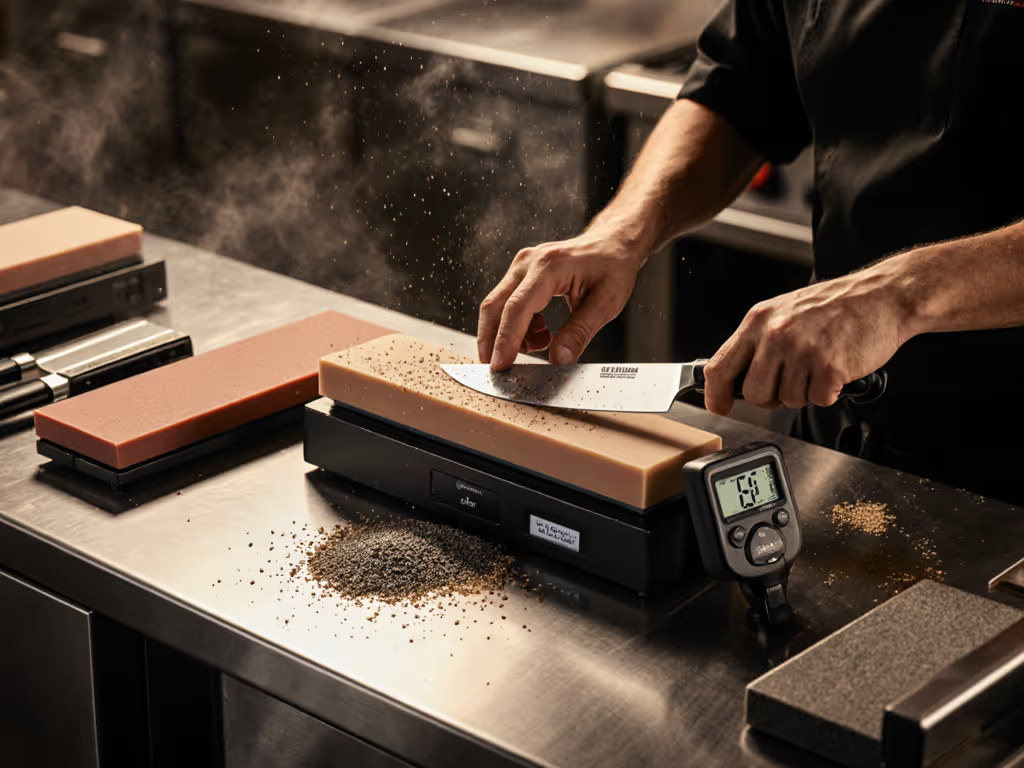
In independent testing, the HORL 2 achieved a BESS score of 248 after just 100 passes on each side with the diamond disc and 10 passes with the ceramic honing disc, placing it in the "ideal range for high-end cutlery."[3] When tested on the same knife again, it scored 259, demonstrating precision angle control and consistency.[3]
The system comes with a 420-grit diamond disc for sharpening and a 1,000-grit ceramic honing disc.[3] Optional 3,000- and 6,000-grit discs allow fine progression without buying a second sharpener.[3] To plan a complete sequence, follow our grit progression guide.
Magnetic Strength and Feel
HORL's magnets are notably strong and clearly outperform many cheaper copies.[1][2] The angle guide is also larger, providing better leverage when sharpening, especially on wide blades or when curving the roller for knife tips.[3] Users note that the roll itself spins smoothly, which grants more control (a tactile checkpoint that matters when you're learning).[3]
Maintenance and Accessories
Both HORL 2 and HORL 3 feature easily replaceable discs. The abrasives themselves are high-quality and built to last; for most home cooks, replacement is infrequent.[1] The HORL 3 system includes a finishing leather strop (also called a leather finisher), which removes metal residue and yields a polished edge.[2]
Work Sharp: The Modular Approach
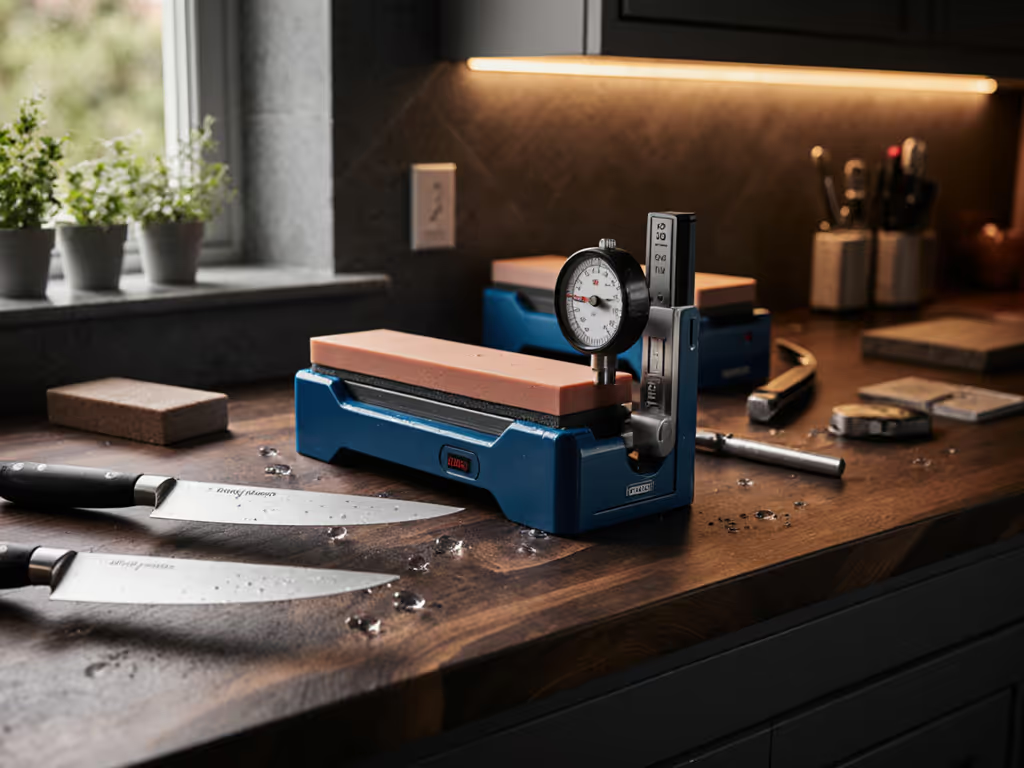
The Work Sharp Professional Precision Adjust takes a different angle: it's a larger, more robust system designed to handle a broader variety of blade types and configurations, including serrated and specialty edges.[4]
Core Features
Work Sharp's discs are 2.25 inches in diameter, larger than HORL's 2.1 inches, which can reach the top of wider blades without repositioning.[3] The system includes an adjustable blade clamp that you can micro-tune to match different blade geometries, and a ceramic honing rod recessed into the body for serrated knives and tight crevices.[4]
Edge Results
When tested on the same knife as the HORL 2, Work Sharp required significantly more passes to achieve comparable sharpness. After 200 passes on each side with the diamond disc, it scored 515.[3] On a Wusthof Classic, it scored 813 after 200 passes per side, a notably slower progression than HORL.[3] The consensus from testing: Work Sharp's performance ranked below both HORL and the Tumbler in sharpness outcomes.[3]
Magnetic Strength
Work Sharp's magnets were stronger than HORL 2's but weaker than the Tumbler's.[3] However, for most knives in the home cook's rotation, the strength is adequate; the real advantage lies in the adjustable clamp, which can hold an off-angle blade or a smaller specialty knife that pure magnetic holders might struggle with.[4]
Side-by-Side Comparison: The Checkpoint Framework
| Criterion | HORL 2 | Work Sharp |
|---|---|---|
| Passes to sharpness (BESS 248+) | ~100 per side | ~200 per side |
| Magnetic strength | Strong; weaker vs. Work Sharp | Stronger than HORL 2; adjustable clamp adds versatility |
| Disc size | 2.1 inches | 2.25 inches |
| Rolling smoothness | Notably smooth; more control | Adequate; larger footprint |
| Specialty blade compatibility | Limited (serrations awkward) | Honing rod built-in; clamp handles off-angle blades |
| Disc replacement | Easy; options to 6,000 grit | Discs available; fewer grit options |
| Finishing touch | Optional leather strop | None included |
| Footprint & setup time | Compact, quick | Larger, more modular setup |
FAQ: Which System Is Right for You?
Does HORL actually produce sharper edges faster?
Yes, within the scope of testing, HORL 2 reaches sharpness benchmarks in roughly half the strokes required by Work Sharp.[3] This translates to 10-15 minutes of actual work versus 20-30 minutes. For weekly maintenance or rapid re-profiling, the HORL's efficiency matters. If speed and consistency are your primary concerns, HORL edges you ahead. Control the angle, control the outcome: steel tells the truth. HORL's simpler, fixed-angle design delivers tighter feedback loops.
What if I sharpen serrated or specialty knives?
Work Sharp wins here. For technique specifics and tool choices, see our serrated edge maintenance guide. Its recessed ceramic honing rod reaches serration valleys; the adjustable clamp accommodates odd blade geometries (recurves, cleavers, and off-center blades).[4] If your collection includes these, Work Sharp's versatility justifies the longer learning curve and slower pass count. HORL is built for straight-edge kitchen and EDC knives; forcing serrations into the roller is awkward.
Do I need replacement discs?
HORL users have transparent upgrade options: 3,000- and 6,000-grit discs offer a full progression without switching systems.[3] Work Sharp discs wear faster according to users, and grit variety is more limited.[1] If you plan to scale up your edge finishing (say, moving from 1,000 to 6,000 grit for harder steels like S35VN or M390), HORL's disc ecosystem is clearer.
Which is quieter and messier?
Both are quieter than whetstones and generate minimal water splash. HORL's compact rolling action is nearly silent, a checkpoint you'll appreciate in a shared apartment or late-night kitchen. Work Sharp's larger footprint and adjustable clamp mean slightly more moving parts and a marginally busier workspace, though neither is disruptive.
Can I use these on my expensive chef's knife?
Both are safe for high-end blades because they lock the angle and eliminate the guesswork that wrecks geometry. Neither will mar a damascus cladding or damage a fine handle, the contact is blade-only. The key difference: if your blade is an unusual shape or has a specialty edge, Work Sharp's adjustability provides an insurance policy. For standard chef's knives and paring knives, HORL's simplicity is an asset, not a liability.
What's the learning curve?
HORL is turnkey. Press the magnetic guide to the blade, roll the disc, count your strokes, flip, repeat. Within three sharpening sessions, the motion becomes automatic (a checkpoint you'll feel).[1] Work Sharp requires more reading: adjusting the clamp angle, understanding when to use the honing rod, managing the larger assembly. For how different guide technologies affect precision, compare magnetic vs mechanical guides. If you're learning, HORL reduces cognitive load. If you're tinkering, Work Sharp rewards patience.
The Honest Assessment: Steel Dictates
Neither system transcends the fundamentals: your steel's hardness, the abrasive grit, and the angle you choose determine the edge quality. Work Sharp doesn't fail because it's worse; it takes longer because its larger disc surface area distributes force over more blade real estate, which can reduce cutting efficiency per stroke. HORL's smaller disc concentrates pressure, accelerating the abrading action.[3]
For a home cook sharpening twice a month, HORL's speed advantage feels luxurious but isn't critical. For someone managing a rotation of specialty knives (serrated bread knives, boning blades, outdoor tools), Work Sharp's flexibility pays for itself in saved frustration.
Mastery, ultimately, comes from deliberate practice with clear feedback. Both systems provide that scaffold. HORL offers precision and speed; Work Sharp offers adaptability and room to grow. Your choice depends on whether you value efficiency or versatility, and whether your knife collection is uniform or diverse.
Further Exploration
If you're ready to choose, audit your knife rotation: count how many straight-edge knives versus specialty blades you own. Time how long you're willing to spend on sharpening per month. Measure your workspace. These constraints (not brand loyalty or marketing) reveal your system. Then commit to checkpoint-driven practice: count your strokes, note the sound and feel of the burr, and track your edge quality week to week. Steel tells the truth only when you listen consistently.
Related Articles